National Park Entry Changes

National Park Entry Changes
By Jeff Ayers
Planning on visiting a National Park this year? There have been several changes, and they could cause issues.
ENTRY FEE CHANGES
The cost has stayed the same for the vast majority, but visitors from other countries or non-United States residents will face a drastic increase. Not all parks charge entry fees, but those that do charge U.S. citizens $35 per vehicle, while non-residents will now pay $100 per person.
What’s behind the price increase? According to the official statement, it’s to ensure “U.S. taxpayers, who already support the National Park System, can continue to enjoy affordable access, while international visitors contribute their fair share to maintaining and improving our parks for future generations.” This executive order highlights American families, adding an extra financial barrier for foreign tourists wanting to experience these parks. The end result will be lower attendance than in previous years, and foreigners will spend their money on park entry, leaving them with less to spend on businesses in and around the park that rely on tourist dollars.
FREE ADMISSION DAY CHANGES
Last year, Martin Luther King Jr. Day (the third Monday in January), the first day of National Park Week (April), Juneteenth (June 19), the Great American Outdoors Act anniversary (August 4), and National Public Lands Day (fourth Saturday of September) were all free entry for visitors. Now those five require admission fees on those days. The days that have changed this year include Trump’s birthday (Flag Day) (June 14), the 110th anniversary of the National Park Service (August 25), and Constitution Day (September 17). The free days used to apply to all visitors, but only U.S. residents will have free entry now. Non-residents will still have to pay the $100 per person.
AMERICA THE BEAUTIFUL ANNUAL PASS
The cost of this pass goes directly to the Park Service, and there are special deals for military and seniors. The fee has stayed the same for the vast majority, as a resident pass costs $80, and has been that price for several years. The newly created non-resident pass, however, costs $250, an additional $170.
THE LAW SURROUNDING THE AMERICA THE BEAUTIFUL ANNUAL PASS
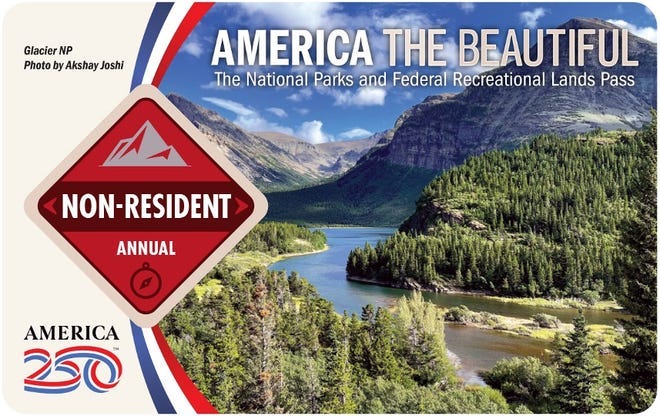
The Federal Lands Recreation Act requires public participation in establishing or changing fees. That didn’t happen. Another law, 16 United States Code 6804, states that the image on the pass be selected annually through a competition. This year’s picture should be of Akshay Joshi’s photo of Glacier National Park. It was moved to the newly created Non-Resident Pass.
The annual pass for U.S. Residents is this image.
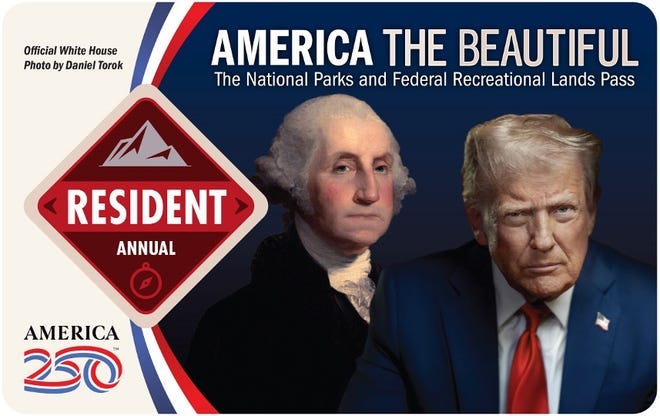
The lack of discourse on the fee changes and the removal of the winning photo from the main annual pass both violate Federal law. The images should be swapped so the winning image is on the correct resident pass, and non-residents are reminded of whom to thank for the higher cost.
LAWSUIT AND OPTION TO COVER UP THE CURRENT IMAGE
The Center for Biological Diversity has sued, saying, in addition to the law violations, that it’s disgusting to politicize America’s most sacred refuge by pasting Trump’s face on the card, and the national parks are not a personal branding opportunity.
Scott Graham mentioned in his post last week that one can buy a sticker designed to cover the front of the card and provided a link to Sage Studios.
Artist Jenny McCarty designed this terrific artwork, and purchasing a sticker supports nonprofit National Park organizations. This comes with a caution, however. The National Park Service staff were told in a recent internal email that a sticker over Trump’s face should be considered altered, rendering the pass void. This would include sticker residue left on the card, even with the image legible and intact.
The solution? In addition to purchasing the card, obtain a clear plastic card sleeve and place the sticker on it. Artist Mitchell Bowen sells $12 plastic sleeves with a National Park design on his website (
https://recollection-project.com/
), and a portion of the proceeds goes back to the parks. They appear to be sold out at the moment, but he says more will become available soon. Just make sure, if you go this route, that you pull the card out of the sleeve before approaching the gate.
A CALL TO ACTION
With the price changes and other issues discussed in other essays on our Substack, this year will be critical for the parks’ future. If you can, visit them and thank the rangers and staff for their hard work in maintaining the sites for future generations.
Jeff Ayers is the author of several books, including Voyages of Imagination: The Star Trek Fiction Companion for Simon and Schuster/Pocket Books. He has interviewed hundreds of authors for magazines, newspapers, and podcasts and has been a book reviewer for The Associated Press and Booklist. He currently reviews suspense thrillers and mysteries for Library Journal, Criminal Element, and firstCLUE. Jeff co-writes the National Park thriller series for Minotaur under the name A.J. Landau and co-writes the Jigsaw Puzzle Mysteries for Crooked Lane. He is a retired public librarian and former co-executive director for ThrillerFest. He lives near Seattle, Washington.
Thank you, Jeff, for pointing out the illegality of the Trump administration changing fees without allowing public input as required, as well as the elimination by the administration of free entry to our national parks on our two federal holidays honoring Americans of color. Scott Graham
When the lines get long, and they will, at the park entrance stations, will the rangers continue to ask everyone for identification, or will they selectively only ask visitors who they determine to be “non residents”? The Trump administration is putting the rangers (most of whom are seasonal employees) working at the entrance stations in situations that will expose them to serious legal issues.